%20(1)-1.svg)

If you have a podcast, you’ve probably heard that audio quality directly impacts podcast growth and monetisation. After all, there are 4.7 million* podcasts worldwide. And each one is competing for listeners' attention.
The problem is, when audio is hard to follow, listeners drop off earlier and are less likely to come back. Over time, that affects completion rates, repeat listens, and the signs platforms and sponsors care about.
Audio quality defines how your podcast is experienced and directly impacts retention, credibility, and revenue.
|
Key takeaways to drive podcast growth and monetisation:
|

Podcast audio quality directly influences trust and credibility
Let’s get a bit more specific. When podcast audio is clean and consistent, people tend to relax into it. They’re not thinking about the sound anymore, which means they can focus on what’s being said.
When it isn’t, you might still hear the words, but it takes a bit more effort. You’re filling in gaps, adjusting, trying to stay with the conversation. It’s small, but it adds up. And over time, it affects how the message comes across.
There’s research behind this. Peer-reviewed studies have shown that when audio quality drops, people rate the same information as less trustworthy and less credible.
|
As soon as we reduced the audio quality, all of a sudden, the scientists and their research lost credibility." When the audio was harder to hear, viewers rated the talk as worse, the speaker as less intelligent and less likeable, and the research as less important. (USC Today) |
You can see the implication straight away.
If your podcast is about building authority, sharing expertise, or representing a brand, audio quality plays a role in how seriously that message is taken. It’s happening in the background, but it’s happening every time someone presses play.
As Cue Podcasts puts it;
“Increased brain effort needed to digest poor audio quality led to decreased engagement, even with high-quality content."
And once that impression is set, it’s hard to undo.
Retention is key to podcast growth
Most podcasts grow because people come back. That sounds obvious, but it changes how you think about audio quality. If someone drops out halfway through an episode, it’s a lost listen and a missed chance to build a habit. When that happens often enough, the show never gets a chance to grow.
Platforms track this closely using completion rates, average listen time, and whether someone queues the next episode. These are the signs that determine how widely your content gets surfaced and recommended.
Podcast audio quality plays a direct role in all of them.
When the sound is easy to follow, people stay with the conversation. They’re more likely to finish the episode, and finishing makes it far more likely they’ll come back. Over time, that’s what turns casual listeners into a consistent audience.
|
41% of listeners will NOT give a podcast a second chance if the first impression disappoints. Poor audio, excessive background noise, pixelated video, and rambling intros are cited as the top killers of retention. (Bamby Media). And 5% of weekly news consumers quit a podcast specifically because of poor audio quality; 9% also cite inconsistent publishing. (Big Tent Media) |
Here are a few common podcast audio issues:
- levels that jump between speakers
- background noise that comes and goes
- voices that feel distant or thin
- recordings that sound different from episode to episode
None of these will ruin a single episode on their own. But they make the experience feel inconsistent. And inconsistency is what breaks momentum. As a result, you end up with a show that people try, but don’t stick with.
That’s the part that slows growth.
Podcast audio quality: The old way vs the new way
If you speak to most teams or creators, getting consistent, high-quality sound feels harder than it should be. (More setup, more tools, more things that can go wrong.)
That’s determined how podcast production has worked for years. You record in one place, edit somewhere else, fix issues after the fact, and hope everything holds together by the time you publish. It works, but it introduces friction at every step.
But nowadays, instead of stitching together tools and workflows, the focus is moving towards capturing good audio at the source, reducing the need for heavy editing, and keeping everything in one flow from recording through to publishing.
The difference becomes more obvious when you compare them side by side:
|
Traditional podcast workflow (Without Nomono) |
Modern podcast workflow (With Nomono) |
|
Recording depends on controlled environments like studios |
Recording works reliably in real-world environments |
|
Multiple tools for recording, editing, and cleanup |
Integrated workflow from capture to publish |
|
Audio issues fixed manually in post-production |
Audio enhanced automatically during or after recording |
|
Inconsistent quality between episodes or locations |
Consistent output regardless of setup or location |
|
Higher reliance on technical knowledge or specialists |
Accessible for non-technical users and teams |
|
Longer turnaround from recording to publishing |
Faster production cycles and quicker release cadence |
You can see the problem here. Each extra step introduces time, cost, and the risk of inconsistency. And that’s usually where momentum starts to slow down. Episodes take longer to produce, quality varies by setup, and teams spend more time fixing issues than creating content.
|
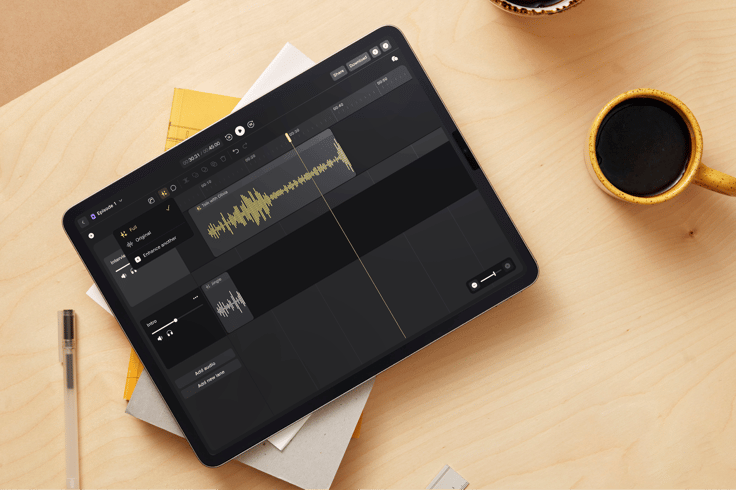
Want to cut this down to a few clicks? That’s essentially what Nomono does. Check out the Sound Capsule |
Take this a step further, and it starts to affect output. Fewer episodes, less consistency, and slower audience growth.
A more streamlined approach changes things significantly.
When audio is captured cleanly from the start, and the workflow stays simple, you remove a lot of the friction that holds teams back. That makes it easier to publish regularly, maintain quality, and keep listeners coming back.
Better podcast audio improves monetisation by strengthening key performance signs
At some point, every podcast considers how to make it commercially viable. That might mean sponsorship, branded partnerships, internal ROI, or simply justifying the time and budget going into production. (It usually comes back to performance.)
Sponsors and stakeholders look for things like:
- how many people listen all the way through
- whether listeners come back for the next episode
- how engaged the audience feels
- how credible the show sounds
Audio quality feeds into all of these. For instance, if listeners drop off early, ad spots in the middle or end of an episode lose value. If episodes feel inconsistent, it’s harder to build a reliable audience. Or if the overall experience feels rough, it can affect how comfortable brands feel being associated with the show.
There’s good data behind this. Over 70% of podcast listeners complete most or all of an episode, which is significantly higher than video completion rates on most platforms.
And behaviour is what monetisation depends on.
Podcast ad spend: the market is real and growing
|
Advertisers care about attention. Brands care about perception. And internal teams care about whether the content reflects well on them.
Audio quality sits underneath all three.
[Nomono was built to deliver this level of quality without all the technical overhead.]

For branded podcasts, audio quality determines brand perception
If you’re running a business podcast, the stakes are a bit different. You’re trying to grow an audience and represent a brand.
That shows up in small ways:
- The way voices sound.
- How clean the mix is.
- Whether the whole thing feels considered or thrown together.
Most listeners won’t call it out directly, but they will form an impression. And that impression sticks.
There’s research to back this up. Branded podcasts already benefit from high levels of attention and trust, with many listeners saying they feel more favourable towards a brand after engaging with its content. That’s a strong starting point.
|
“61% of branded podcast listeners say an episode made them somewhat or much more favourable toward the brand.” |
But this positive effect depends on the experience holding up. If the audio feels polished and consistent, it reinforces the idea that the brand knows what it’s doing.
If the audio is uneven or distracting, the opposite can happen. It introduces doubt and makes the content feel less considered, even if the ideas are strong.
For teams investing in podcasts as a way to build authority, attract customers, or engage internally, this feeds into how the brand is perceived every time someone listens.
And over time, that perception compounds.

The real standard is consistent, professional podcast audio, wherever you record
There’s a tendency to think in extremes when it comes to podcast audio. At one end, you have full studio setups with treated rooms, complex gear, and dedicated engineers. At the other end, are quick recordings on whatever device is available.
Most teams sit somewhere in between, trying to get good results without turning production into a full-time job.
The issue is that quality often gets tied too closely to the environment.
If you can achieve great sound only in a controlled space, it limits where and how you can record. That’s fine for some formats, but it doesn’t work well for interviews, events, or anything that happens outside a studio.
The good news is, advances in recording hardware and audio processing, like Nomono, mean you can now capture high-quality sound in a much wider range of conditions, and keep that quality consistent from one episode to the next. Which means less dependency on perfect environments, more focus on reliable output.
You still want the result to meet a professional standard. That hasn’t changed.
What has changed is the standard's accessibility.
Here are two examples.
- recording a panel discussion at an event, where each speaker is captured clearly, and background noise is controlled
- recording an interview on location, with consistent levels and minimal post-production needed to get it ready for publishing
In both cases, the goal is audio that feels clean, balanced, and easy to listen to. The difference is that you’re no longer limited to one type of setup to get there. And once you can rely on that level of quality wherever you record, it becomes much easier to produce consistently, publish more often, and keep the experience aligned with your brand.
Related reading: How to record a professional podcast anywhere
The cost of bad audio is lost momentum
This is the part that tends to get overlooked. Most teams think about audio quality in terms of how it sounds. What gets missed is how it affects everything around the process.
When recordings aren’t clean to begin with, the work heads downstream. Which means more time fixing levels, removing noise, cutting around issues, sometimes even re-recording.
You can see it in the workflow:
- Editing takes longer than expected
- The turnaround between episodes stretches out
- Small issues turn into delays
- Publishing becomes less consistent
It’s a series of small issues that slow everything down. As a result, output drops. And fewer episodes means fewer chances to reach listeners. Plus, inconsistent publishing makes it harder to build a habit with your audience. Over time, growth stalls, even if the content itself is strong.
There’s also the team side of it.
If you rely on complex setups or heavy post-production, you limit who can contribute. Recording becomes something that needs planning, coordination, and sometimes specialist support. That’s manageable at a small scale, but it doesn’t scale easily.
Now compare that to a workflow where audio is captured cleanly from the start.
Editing becomes lighter, turnaround shortens, and publishing feels more predictable. Which means teams can focus more on the content itself rather than fixing technical issues.
This consistency is what keeps a podcast moving forward
A simple way to think about audio quality
It helps to step back and look at this without overcomplicating it.
Audio quality feeds into four things that actually move a podcast forward:
- Credibility: If the audio is clear and balanced, people are more likely to trust what they’re hearing.
- Retention: When it’s easy to listen, people stay longer and are more likely to finish the episode.
- Consistency: Reliable sound makes it easier to publish regularly without heavy production overhead.
- Commercial value: Strong engagement and a professional feel make the show more attractive to sponsors or stakeholders.
Each builds on the other.
If credibility is there, listeners are more open to the message. If retention improves, growth starts to compound. If consistency is in place, the show becomes something people can rely on. And once this all works together, monetisation becomes a much more realistic outcome.
So instead of thinking about audio quality as a technical standard, it’s more useful to think about it as part of the overall performance of the show.
It’s one of the inputs that shapes how the podcast actually behaves over time.
How to improve podcast audio quality without overcomplicating your setup
This is where most people get stuck. You start looking into audio quality and suddenly you’re deep in forums, comparing gear, reading about setups that feel over-engineered for what you actually need. It’s easy to lose momentum before you even hit record.
There’s a simpler way to approach it. (This is where tools like Nomono really come into their own.)
Focus on the parts that directly affect the listening experience and ignore everything else for now.
Here’s where I’d start.
- Capture clean audio at the source: Get the microphone close enough to the speaker and avoid relying on built-in laptop or phone mics. Most issues are much harder to fix later than they are to prevent upfront.
- Reduce noise before you record: Small changes make a difference. Close doors, turn off anything that hums, and be aware of your environment. You don’t need a treated studio, just fewer distractions in the background.
- Keep levels consistent: One of the fastest ways to lose a listener is making them adjust volume mid-episode. Aim for steady, balanced levels across speakers from the start.
- Standardise your setup: Use the same approach each time you record. Same mic position, same tech, similar workflow. Consistency removes a lot of variables.
- Use tools that simplify the process: Nomono is perfect for this. Audio enhancement, levelling, and noise reduction don’t need to be manual anymore. Tools designed for spoken audio can handle a lot of this automatically, which saves time and keeps output consistent.
- Listen back with intent: Not just for what’s being said, but how it sounds. Background noise, clarity, and pacing. You’ll catch patterns quickly and can adjust before they become habits.
Once your workflow is working well, it becomes much easier to scale output, keep quality consistent, and focus on what actually drives the podcast forward.
Better sound helps your podcast grow because it helps your message land
Simply put, a podcast works when the listener stays with you. If the audio is clear, consistent, and easy to follow, your ideas have space to come through. Conversations feel natural, stories hold attention, and people get to the end of the episode and decide it’s worth coming back.
That’s where growth starts to compound.
Audio quality defines how your podcast is received from the first few seconds onward, and it carries through everything that follows. Retention, growth, and monetisation all build from that same foundation.
If you’re investing time and effort into a podcast, it’s worth making sure nothing gets in the way of the message being heard.
Keen to improve your podcast workflow? This is exactly what Nomono’s been built for. Check us out.
*https://www.limelightdigital.co.uk/podcast-statistics/