%20(1)-1.svg)


Search for “best podcasting equipment” and you’ll find no shortage of lists telling you what to...
Podcasting in education is the use of audio recording and publishing to support teaching, assessment, and communication skills – whether that is a student-produced classroom project, a faculty research series, or a department's public-facing show. It has quietly become one of the most effective formats in education. From middle school classrooms to university departments, it gives students a way to develop real communication skills and gives educators a flexible tool for both teaching and assessment. Whether it is a student podcast project, a faculty research series, or podcasting in the classroom as an alternative to traditional assignments, the format works across levels and disciplines.
But here is the problem most schools run into: the technology gets in the way. Setting up microphones, managing cables, troubleshooting interfaces, dealing with memory cards and editing software – it adds up fast. The programs that actually succeed are the ones that remove that friction, so teachers and students can focus on content instead of gear.
This guide covers the benefits of podcasting in education, what real institutions are doing with it, how to start a podcast project in a classroom or university, and what kind of setup actually makes it sustainable.
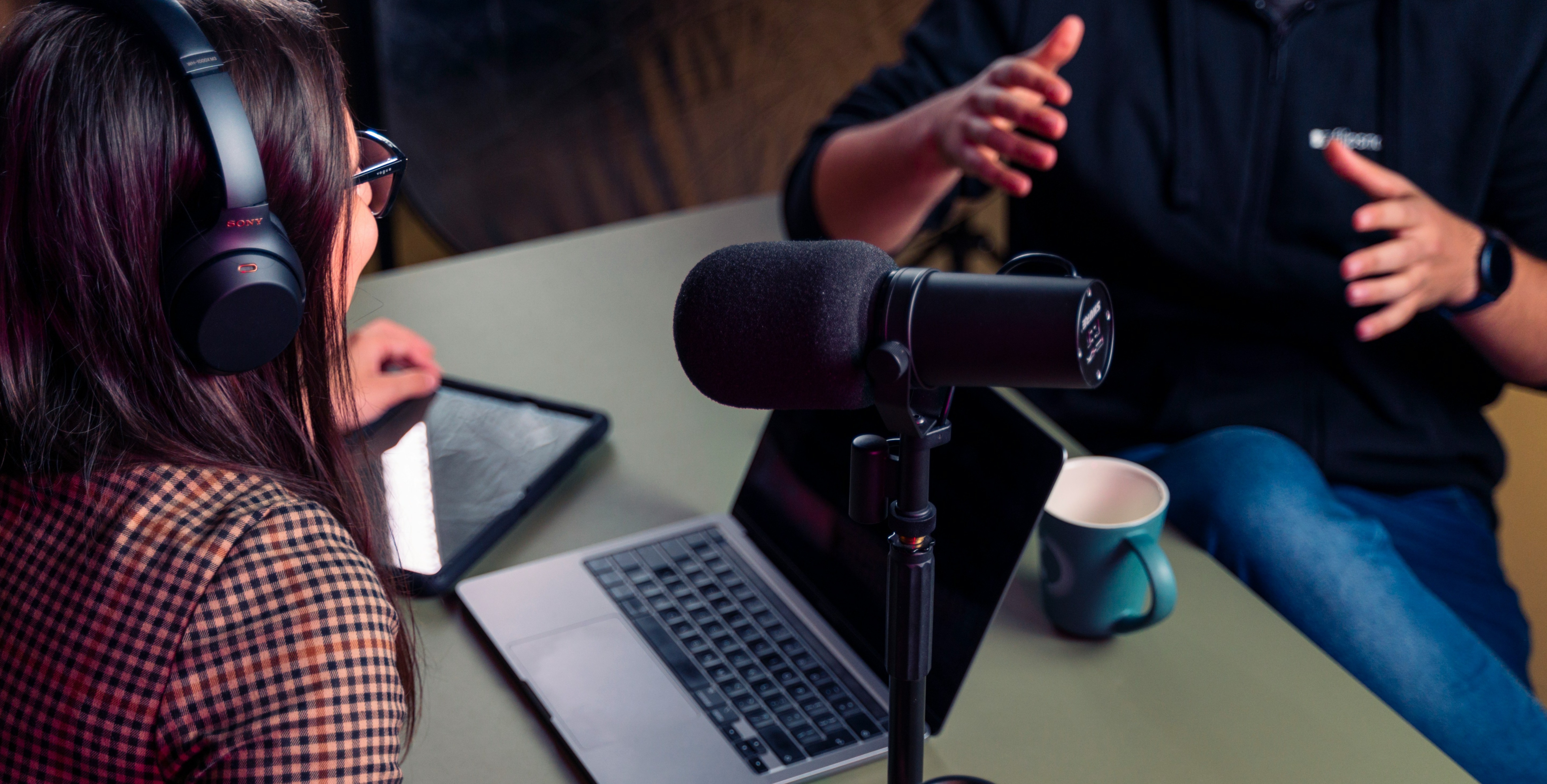 Photo by Flipsnack on Unsplash
Benefits of podcasting in education
The reason podcasting keeps gaining traction in schools is not because it is trendy. It is because the format naturally supports the kinds of learning outcomes that matter most: critical thinking, clear communication, collaboration, and the ability to organize ideas for a real audience.
When students plan, research, script, and record a podcast episode, they are doing something fundamentally different from writing an essay or sitting through a lecture. They have to synthesize information, make editorial choices, speak clearly, and work with others on a shared deliverable. That is active learning by any definition.
Audio also has practical advantages that other formats do not. Students can listen to course content away from a screen, which makes podcasts useful for review, commuting, and asynchronous learning. When paired with transcripts, podcasts become an accessibility tool as well, giving students multiple ways to engage with the same material.
And in 2026, the infrastructure around podcasting has matured significantly. AI-powered transcription is now accurate enough to generate usable show notes, searchable text, and accessibility-ready transcripts with minimal manual cleanup. Cloud-based editing tools have lowered the post-production barrier so that students and faculty can collaborate on episodes without needing to install professional audio software. These changes mean that the workflow has caught up with the pedagogy – the format is now as practical to produce as it is effective to teach with.
Real-world examples of podcasting in education
Educational podcasting is not theoretical. Institutions across the spectrum are using it in different ways, and the variety of educational podcast formats shows how adaptable the medium really is.
Department research and thought leadership. Stanford Graduate School of Business launched If/Then to give professors a platform for discussing their research in a conversational format. Columbia University's Dead Ideas in Teaching and Learning takes a more pointed approach, with faculty challenging assumptions about how higher education works. Both programs use audio to build intellectual presence without the cost or complexity of video production.
Student-led storytelling. Medical students at the University of Iowa produce The Short Coat Podcast, an unfiltered look at the realities of medical school. At Bowling Green State University, the BG Ideas podcast features interviews with academics, artists, and alumni about interdisciplinary research and its public impact. These are student-driven projects that build real skills while producing content worth listening to.
K-12 projects. At Kairos Leadership Academy, middle school students produce The Bean Bag, interviewing teachers, staff, and fellow students about life at the school. And at the University of Colorado Colorado Springs, history students replaced a traditional essay assignment with an audio "game show" format to test each other on decades of American history. What could have been a routine review exercise became an engaging group project.
Sometimes the podcast host is the visiting guest, not the school. Pam Covarrubias, host of Cafe con Pam, brought a Sound Capsule into a middle school career day and turned it into a live recording session with the students themselves.
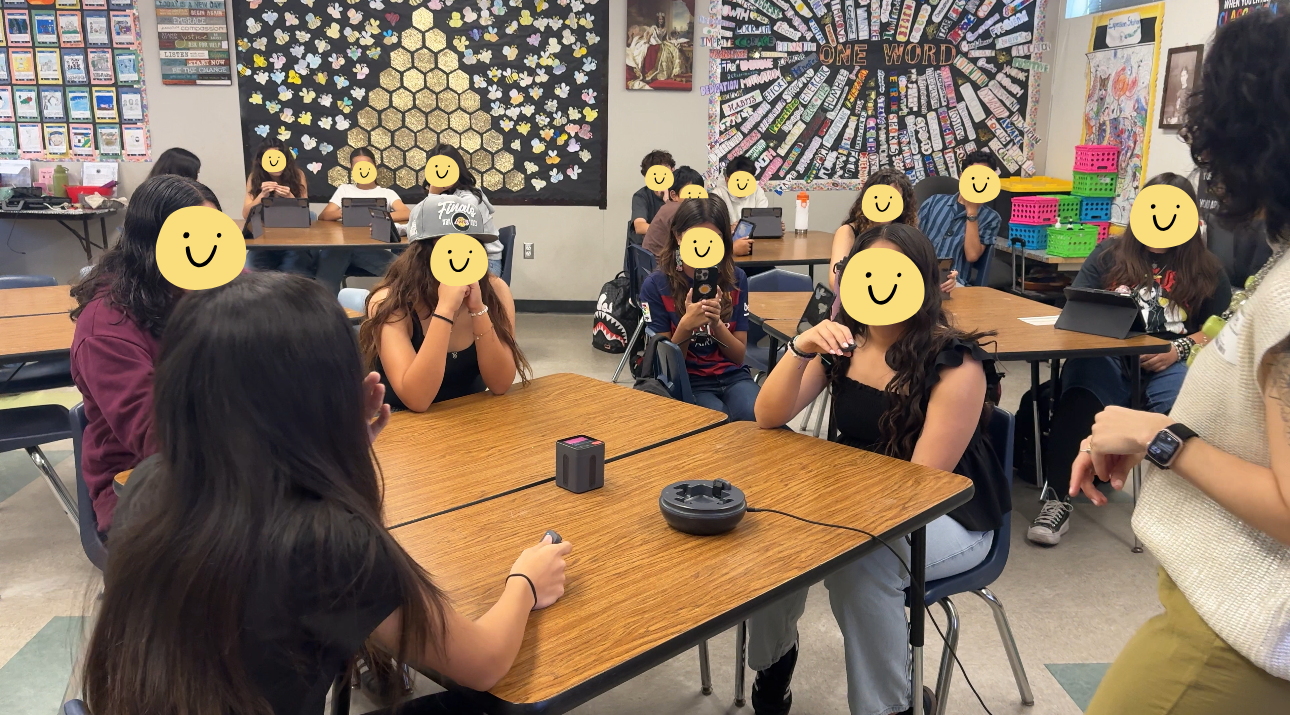
"I brought my Sound Capsule to a middle school career day and recorded a mini podcast with the students right there in the classroom. No mic stands, no tangle of cables, no sound tech in the room. I set the capsule in the middle of the table, hit record and the kids leaned in. I led the students to select talent, producers, writers, and podcast managers, we had a lot of fun. The audio was crisp and clean ready to publish. Those kids walked out thinking they had made real radio. A few weeks later I received hand written cards from the kids thanking me for my session and some even said they were now curious about a career in media because they didn't realize they could be behind the scenes as well as in front of the mic. Having my Sound Capsule ready to capture the audio content, made it a great experience for everyone." – Pam Covarrubias, host of Cafe con Pam
Universities like Lancaster, Liverpool, Texas A&M, Arkansas, and Exeter are also actively using podcasting in their programs, across departments ranging from management to journalism to student media.

Classroom podcast ideas for K-12
For K-12 educators, the key is to tie every podcast project to a clear learning objective. Podcasting should not be a novelty assignment – it should be used because it helps students do something better than they could with a written paper or a class presentation alone.
Some formats that work well across age groups and subjects:
- Book response episodes. Instead of a written book report on The Giver, a group of 7th graders records a 10-minute discussion about why Jonas's community chose to eliminate color, memory, and emotion – and whether they would make the same trade. The conversation forces them to articulate ideas they might never put in an essay.
- History debates. Two teams of 8th graders take opposing sides on whether dropping the atomic bombs on Hiroshima and Nagasaki was justified. Each side has to use primary sources – letters, speeches, military briefings – and the episode becomes a structured argument, not just an opinion.
- Science explainers. A 5th grader records a three-minute episode explaining how photosynthesis works – in language a younger sibling could follow. Teaching a concept in simple terms is one of the hardest and most revealing tests of whether a student actually understands it.
- Language practice. Spanish students record a mock restaurant scene entirely in the target language – ordering food, asking questions, handling a problem with the bill. It is more engaging than a worksheet and produces a recording they can review to hear their own pronunciation.
- School news or class podcasts. A rotating team of students produces a weekly five-minute episode covering school events, sports results, and a student interview. It builds ownership, recurring responsibility, and real speaking confidence over time.
The thing that makes a podcast assignment land is that students know someone will actually listen. When the output is audio rather than a paper that only the teacher reads, students tend to prepare more carefully, speak more clearly, and care more about the quality of their ideas. That shift – from producing for a grade to producing for an audience – is what makes using a podcast as assessment different from most classroom formats.
Podcasting in higher education: universities and colleges
At the university level, podcasting serves a different set of needs. The audience is broader, the use cases span multiple departments, and the content often has a longer shelf life. A good university podcasting program is not just a classroom tool – it can support research communication, recruitment, alumni engagement, and institutional storytelling.
Some of the most common use cases in higher education:
- Faculty research podcasts where professors discuss their work in a conversational format – a 20-minute episode about a new paper on climate migration policy, for example, will reach a far wider audience than the paper itself. This is one of the most effective ways to make academic research accessible without producing a full video series.
- Journalism and media programs where students produce real audio content as part of their coursework – field interviews with local business owners, reported features on housing policy, editorial roundtables on campus issues. These build portfolio-ready skills that translate directly to careers in media.
- Student assessment alternatives where podcast episodes replace or supplement traditional essays and presentations. A political science seminar group recording a 15-minute structured debate on EU trade policy, for example, demonstrates critical thinking in ways a written paper often cannot.
- Campus and department storytelling – an admissions podcast where current students answer the questions prospective applicants actually have, an alumni interview series from the engineering department, or a monthly audio newsletter from the dean's office. These serve both internal audiences and people researching the institution from the outside.
- Seminar and lecture capture where recording guest speakers, panel discussions, or visiting industry roundtables creates a reusable content library that extends the reach of a single event well beyond the room it happened in.
The operational challenge at universities is different from K-12. It is less about a single teacher managing a classroom project and more about making equipment available across departments, locations, and user groups – often with no dedicated audio staff. A setup that lives in one department and requires technical training to operate will not scale. One that can be checked out, carried to a seminar room or a campus bench, and used by anyone with five minutes of orientation will.
Why school podcast projects fail
Most school podcasting programs do not fail because of bad pedagogy. They fail because the setup is too complicated for the people who have to run it.
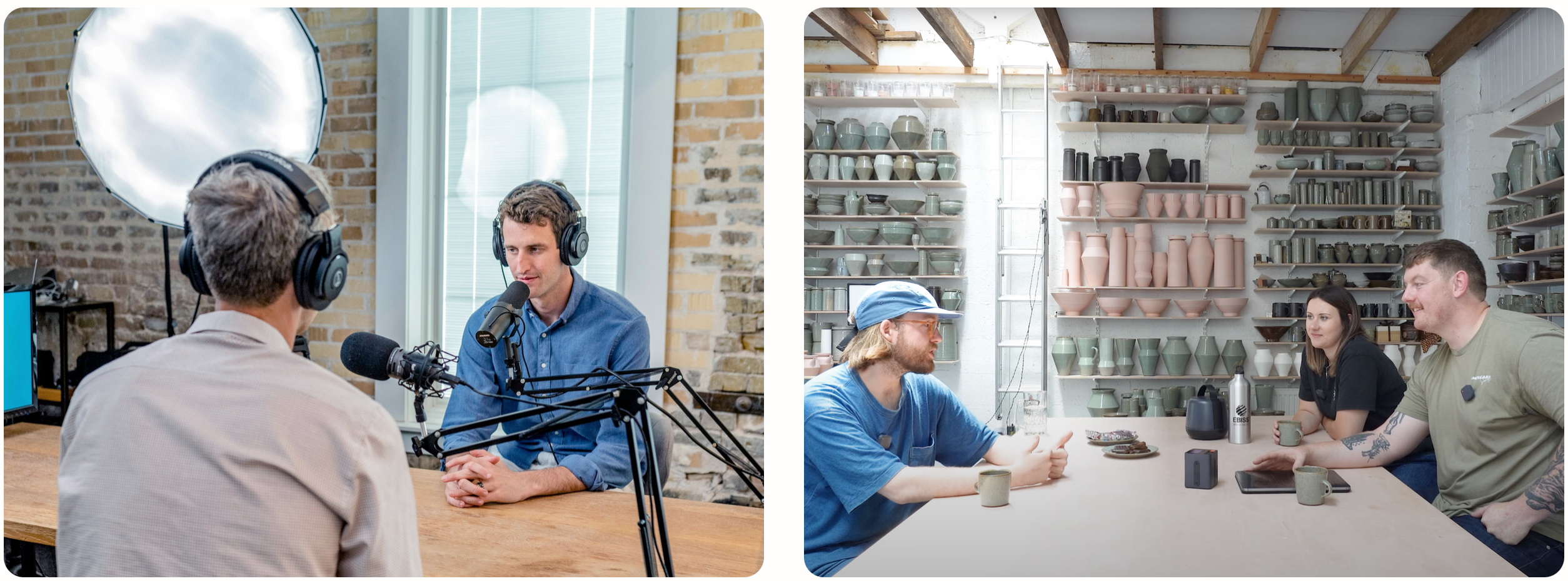
Think about what a traditional podcast workflow looks like: multiple microphones, XLR cables, an audio interface, headphones, a laptop running a DAW, SD cards, gain staging, and then file transfer and editing afterward. That is fine for a dedicated production team. It is not realistic for a teacher who has 30 minutes between classes and no audio background.
The friction shows up in predictable places. Teachers spend too long setting up and troubleshooting. Students lose recording time to technical issues. Files end up scattered across devices. And after one or two painful sessions, the equipment goes back in the closet.
For podcasting to scale in education, the equipment has to work for non-technical users. That means fewer components, faster setup, and a clear path from recording to finished audio without requiring someone to learn professional editing software.
Best podcast equipment for schools and classrooms
If you are evaluating podcast equipment for a school, department, or university program, the checklist is shorter than you might expect. The goal is not to replicate a professional studio. It is to make recording reliable and repeatable for people whose main job is teaching, not audio production. For a broader look at how to choose equipment for any recording setup, see our guide to choosing podcasting equipment.
You need:
- Portable hardware that works across different spaces – classrooms, offices, libraries, outdoor locations – without requiring a dedicated room.
- Wireless microphones so people can sit and talk naturally without cables creating setup time and limiting movement.
- Automatic cloud upload so recordings are accessible immediately, without passing around SD cards or USB drives.
- Transcription support for accessibility compliance and for turning audio into searchable, publishable text.
- Cloud Editor to finalize the episode – cut, trim, add intros and outros, sync with video
A podcast recording setup built for education teams
The Nomono Sound Capsule was built around exactly this problem. It is a portable, all-in-one recording kit with up to four wireless microphones, a one-button recorder, and a cloud-based workflow that handles upload, storage, AI-powered audio enhancement, transcription, and collaboration.
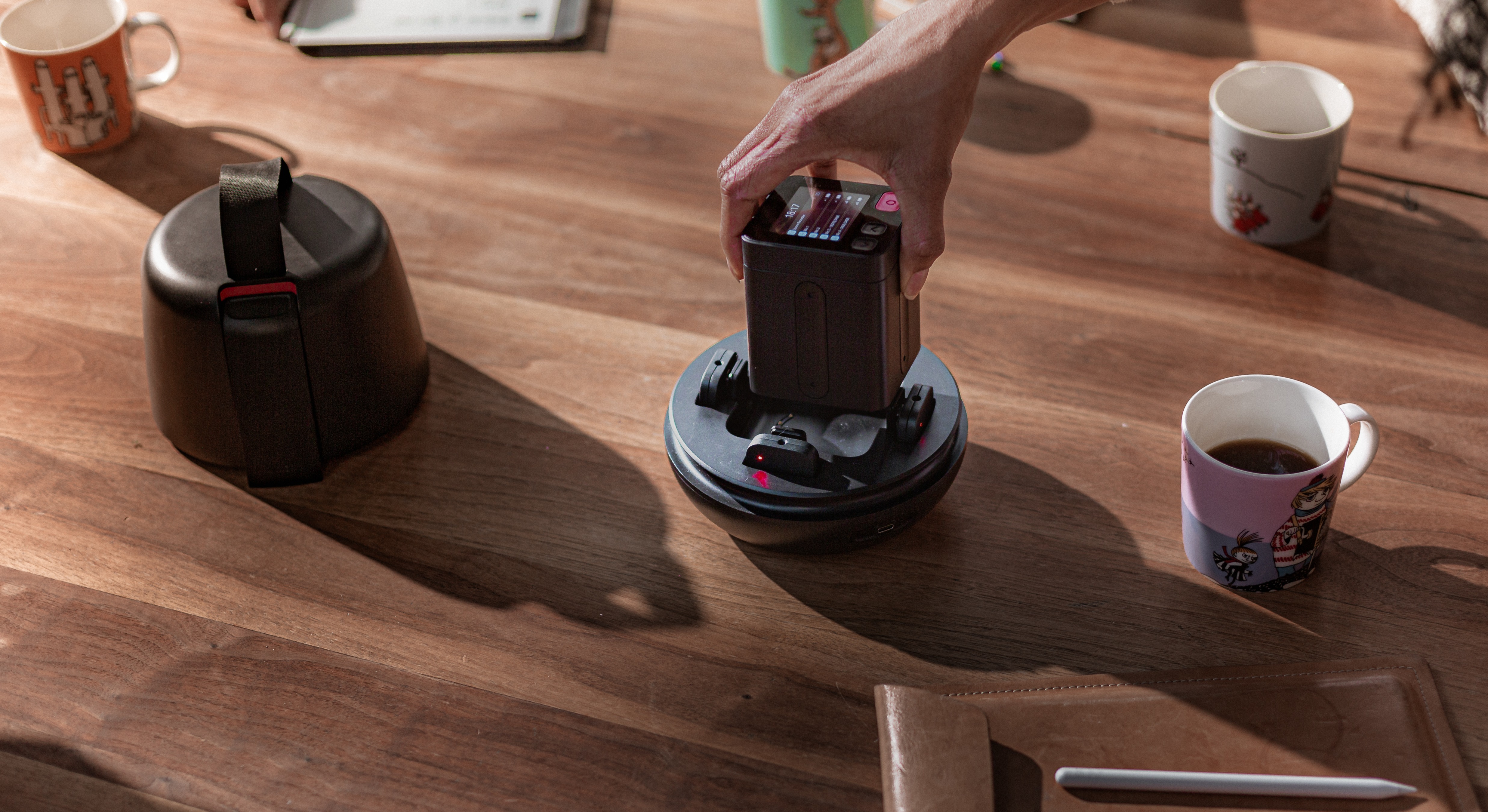 In practice, that means a teacher or student can open the case, clip on the mics, press record, and have broadcast-quality audio uploading to the cloud as soon as they connect to Wi-Fi. No cables, no gain adjustment, no file management. The Sound Capsule weighs under 1.5 kg and fits in a backpack, so it can move between classrooms, campus locations, and field settings without any of the bulk of a traditional recording setup.
"All recordings have come out brilliantly, and more are in the pipeline. The sound quality is always superb – hard to believe it is done on remote mics and not always in a studio." – Paul Turner, Lancaster University Management School
The cloud side matters just as much as the hardware. Nomono Studio lets teams edit, enhance, and collaborate on recordings in a browser. AI-powered noise removal cleans up recordings made in imperfect environments – echoing classrooms, busy hallways, outdoor spaces – and the transcription tools produce text that can be used for show notes, accessibility, or assessment review.
That combination of simple hardware and cloud-based post-production is what makes the difference for education. Faculty do not need to learn audio engineering. Students do not need training on a DAW. The workflow fits into the way schools actually operate, which is why institutions like Lancaster, Texas A&M, Arkansas, Liverpool, and Exeter have adopted it for seminars, student podcasts, campus interviews, faculty content, and journalism programs.
Editing, publishing, and sharing student podcasts
Recording is only half the workflow. Once you have audio, you need a way to edit it, clean it up, and get it in front of listeners. This is where many school podcast projects stall – not because editing is hard, but because nobody planned for it.
Editing. For most classroom projects, editing does not need to be complicated. The goal is to trim dead air, remove false starts, and make sure the audio sounds clear. Cloud-based tools like Nomono Studio, Descript, or Alitu let students and teachers edit in a browser without installing professional software. If a setup like the Sound Capsule and Studio Cloud handle recording, noise removal and audio enhancement automatically, the editing step becomes much lighter – often just trimming and arranging rather than fixing audio problems.
Where to publish. Not every student podcast needs to go on Spotify. The right publishing choice depends on the audience:
- Internal only. For class assignments and assessment podcasts, a shared drive, LMS (Canvas, Google Classroom, Moodle), or a private link is enough. The audience is the teacher and classmates, and there is no need for public distribution.
- School or department website. For recurring shows like school news podcasts or department series, embedding an audio player on an existing website is a simple way to make episodes available without managing a separate platform.
- Public podcast directories. For programs that want wider reach – journalism projects, student media, alumni series – you will need a podcast hosting platform. Spotify for Creators (free), Buzzsprout, Podbean, and Blubrry (which offers free hosting for educators and 50% off for students) all generate an RSS feed that distributes your show to Spotify, Apple Podcasts, and other directories automatically. You upload once, and the episode appears everywhere.
A note on privacy. Before publishing student audio publicly, check your school's policies on student media, parental consent, and data privacy (FERPA in the US, GDPR in the UK/EU). Many schools default to keeping student podcasts internal unless there is explicit consent for public distribution. Building this into the project planning from the start avoids complications later.
How to start a successful student podcast project
- Start with the learning goal, not the technology. Before anyone touches a microphone, decide what the assignment is meant to build: subject understanding, analytical thinking, presentation skills, collaboration, or storytelling ability. The format should follow the objective.
- Keep episodes short and structured. Open-ended "just record a conversation" assignments tend to produce unfocused audio. Give students a clear prompt, a time limit, and defined roles (host, interviewer, researcher, editor). Constraints produce better work.
- Build a rubric that assesses what matters. Grade on structure, clarity of ideas, depth of content, collaboration, and use of sources – not on production polish. The goal is to evaluate thinking and communication, not audio engineering skill.
- Prioritize audio quality at the source. This does not mean buying expensive equipment. It means using wireless microphones that capture clean voice recordings, choosing quieter spaces when possible, and using tools that handle noise reduction automatically. When recordings sound clear, students and teachers are more likely to keep using the format.
- Be intentional about publishing. Not every podcast needs to go public. Some episodes work best as internal class assignments. Others can be published as department content, school news, or student media. Decide the audience before recording, because it shapes how students approach the work.
How to get started with podcasting in education
Podcasting in education works because it combines subject mastery, communication skills, and creative production into a single assignment format. It scales from a one-off classroom project to a recurring department program. And with the right tools, it does not require anyone to become an audio professional.
The schools that succeed with podcasting are the ones that keep the workflow simple enough that teachers actually use it, students enjoy the process, and the program can grow beyond a single class or semester.
→ Explore Nomono for Education to see how a portable, wireless recording kit and cloud-based workflow can support classrooms, libraries, makerspaces, journalism programs, and university teams.